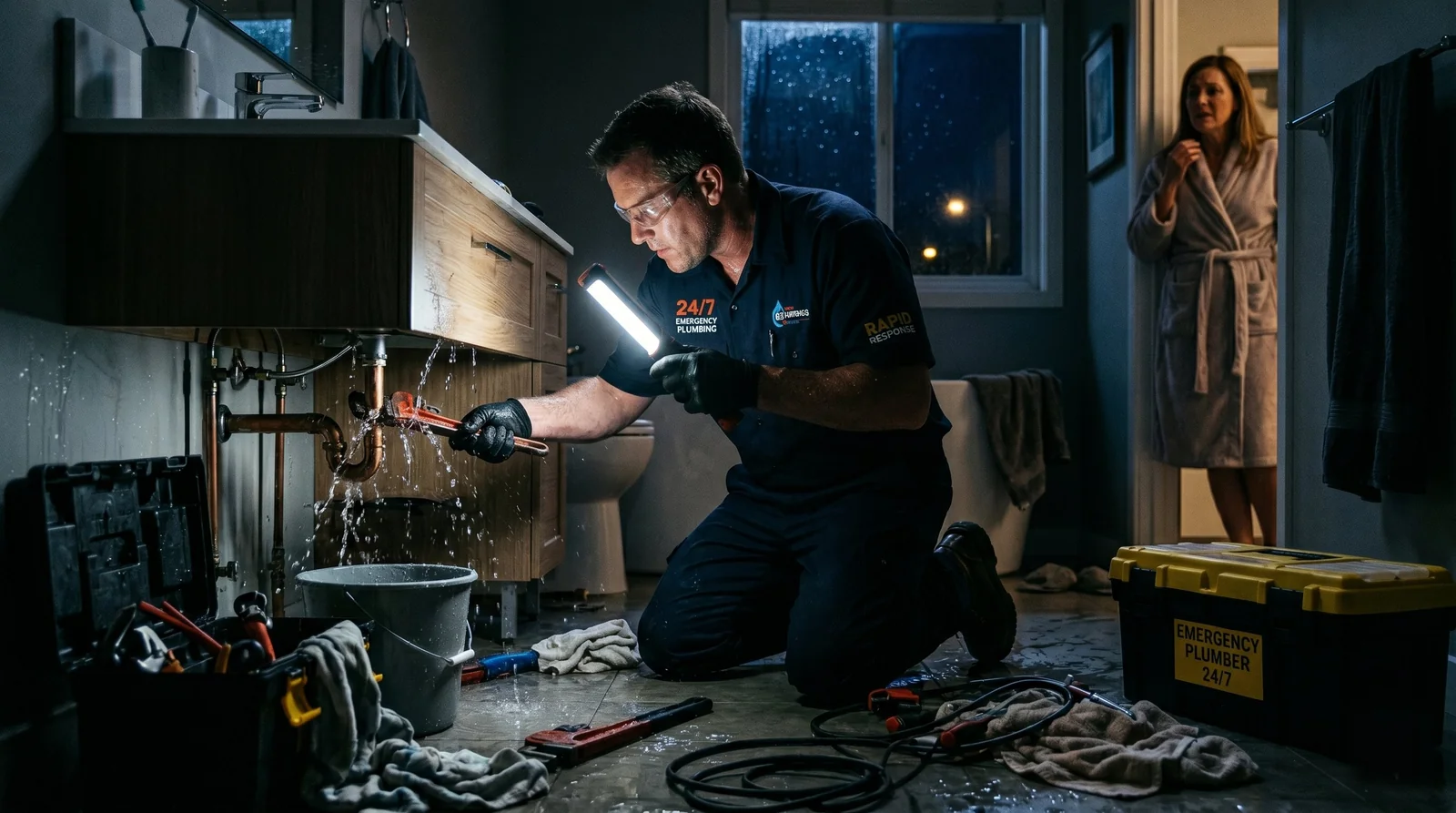
11pm Tuesday. A pipe bursts in someone's Cessnock kitchen. They Google "emergency plumber Newcastle." Who do they call? Whoever shows up first.
That call is worth 3 to 5 times more than a daytime call. The customer isn't comparison shopping. They aren't asking three plumbers for quotes. They're calling the first number they see that looks legitimate.
And almost every plumber's Google Ads setup is structured to lose that call.
Here's why, and how to fix it.
Why after-hours searches are different
Three things change about a search the moment it crosses 6pm on a weekday or any time on a weekend:
The intent is more urgent. Daytime plumbing searches are mostly "blocked drain," "hot water replacement," "tap repair," researched calmly. After-hours searches are "emergency plumber [suburb]," "burst pipe," "no hot water," and the urgency goes up.
The competition is different. Most plumbers pause their Google Ads at 5pm or set them to "standard" delivery which spreads the daily budget evenly across the day. So at 11pm, half the local competition isn't even running ads.
The conversion rate is higher. Across the tradie accounts I manage, after-hours emergency campaigns consistently run 3 to 5x higher CTR (click-through rate) and 2 to 4x higher conversion rate than the same keywords during business hours. The CPC (cost per click) is often lower because fewer competitors are bidding.
More of the people clicking actually call. Across the tradie accounts I manage, after-hours emergency campaigns consistently get 3 to 5 times more clicks per ad shown, and 2 to 4 times more of those clickers actually call. The cost per click is often lower because fewer competitors are bidding at those hours.
That's the opportunity. Now the setup.
The 5-part after-hours setup
1. A separate emergency campaign (not just ad group)
The single biggest mistake is treating "emergency plumber" as another ad group inside the main campaign. Bidding strategies, budgets, and dayparting all live at the campaign level in Google Ads. If your emergency keywords share a campaign with "tap repair," they share a budget and a schedule, which kills the strategy.
The single biggest mistake is putting "emergency plumber" in the same campaign as everything else. Budgets and schedules in Google Ads work at the campaign level, not the keyword level. If emergency sits with "tap repair" in one campaign, they share a daily budget and a schedule. That kills the whole strategy.
Emergency gets its own campaign. Separate budget. Separate schedule. Separate ad copy. Separate bid strategy.
2. Dayparting (campaign schedule, not 24/7)
Set the emergency campaign to run only during high-emergency-intent hours: weeknights 5pm to 11pm, Saturday and Sunday all day. Suppress entirely during 9am to 4pm Monday to Friday, because that traffic is captured by the standard campaign.
Set the emergency campaign to only run during the hours when people are actually searching for emergencies. Weeknights 5pm to 11pm. Saturdays and Sundays all day. Turn it off completely between 9am and 4pm on weekdays, because that's normal-hours traffic that the regular campaign covers.
This concentrates budget on high-value moments. Same daily spend, way better return.
3. Emergency-specific keywords (not "plumber" with modifiers)
The keywords that convert at 3 to 5x rates aren't generic "plumber" terms. They're urgent-intent variants:
"emergency plumber [suburb]"
"24 hour plumber [suburb]"
"burst pipe [suburb]"
"no hot water emergency"
"blocked drain emergency"
"after hours plumber [suburb]"
"plumber open now [suburb]"
"weekend plumber [suburb]"
Use exact match and phrase match for these. Broad match dilutes spend on near-matches that don't carry the urgency intent. The emergency campaign should be tightly themed: every keyword has the word emergency, 24 hour, burst, urgent, after hours, or weekend in it.
Use exact match and phrase match (the two strictest keyword types) for these. Broad match (the loosest type) will burn money on near-matches that don't carry the urgency. The emergency campaign should be tightly focused: every keyword has the word emergency, 24 hour, burst, urgent, after hours, or weekend in it.
4. Call-only ads and call extensions
At 11pm on a Tuesday, the customer wants to ring you, not browse your service pages. Call-only ads route the click directly to a phone call. No landing page involved. The whole ad is the phone number plus a one-line message. These typically have CTRs 2 to 3x higher than standard ads for emergency intent.
At 11pm on a Tuesday, the customer wants to ring you, not browse your website. Call-only ads (a special type of Google Ad) send the click straight to a phone call. There's no website involved. The whole ad is your phone number plus a one-line message. These usually get clicked 2 to 3 times more often than regular ads when the intent is urgent.
Use them for the emergency campaign. The standard plumbing campaign can still use regular ads with landing pages, because daytime customers want to compare.
5. Bid up for high-conversion hours
Inside the emergency campaign, layer ad schedule bid adjustments. Bid up 50 to 100% for the peak emergency window (typically 8pm to 10pm weeknights, Saturday morning). Bid up 20 to 30% for adjacent hours. This pushes you to position 1 when it matters most.
Inside the emergency campaign, you can tell Google to bid more for specific hours. Bid 50 to 100% more for the busiest emergency windows (usually 8pm to 10pm weeknights, and Saturday mornings). Bid 20 to 30% more for nearby hours. This pushes you to the very top of Google when it matters most.
Position 1 vs position 3 for emergency searches is the difference between getting the call and not.
3 mistakes to avoid
Running the same ad copy 24/7
Daytime ads talk about reliability, warranty, free quotes. Emergency ads need to talk about speed: "Available now," "20 min response," "After hours plumber on call." Same business, completely different message.
Not pausing daytime campaigns when on a job
If you're a sole-trader plumber and you're already on a 4-hour job, your Google Ads are still spending. The clicks are still costing $8 to $15 each. The calls go to voicemail. The opportunity walks. Use a smartphone bid-pause workflow, or set up automated rules to pause based on a Google Sheets toggle.
If you're a sole-trader plumber and you're already on a 4-hour job, your Google Ads keep spending money. Each click still costs $8 to $15. The calls go to voicemail. The customer rings someone else. Use a phone-based way to pause campaigns when you're on a job, or set up rules that pause based on a simple spreadsheet toggle.
Sending emergency clicks to the home page
Even if you're using regular ads instead of call-only, never send emergency traffic to the home page. They need a dedicated emergency landing page with the phone number above the fold, "available now" messaging, and one job: get the call. The home page has too many distractions.
A real example, anonymised
One of the plumbing accounts I manage in regional NSW runs $40/day total Google Ads spend. We split it: $25 on the standard campaign (9am to 5pm Mon to Fri), $15 on the emergency campaign (5pm to 11pm Mon to Fri, all Sat/Sun).
Last 90 days:
Standard campaign: $2,250 spend, 51 calls, $44 per call.
Emergency campaign: $1,350 spend, 67 calls, $20 per call.
Same business. Same trades. Same service area. Emergency campaign delivers 31% more calls on 60% of the spend, because the structure matches the intent.
If you run a plumbing business in the Hunter
If your current Google Ads setup doesn't have a separate emergency campaign with dayparting, you're leaving money on the table every weekend. Send me the account access and I'll do a free audit. I'll tell you what to change, in what order, and roughly what return to expect.
The full Google Ads service is here. Free setup, 20% of spend after that. No retainer trap.